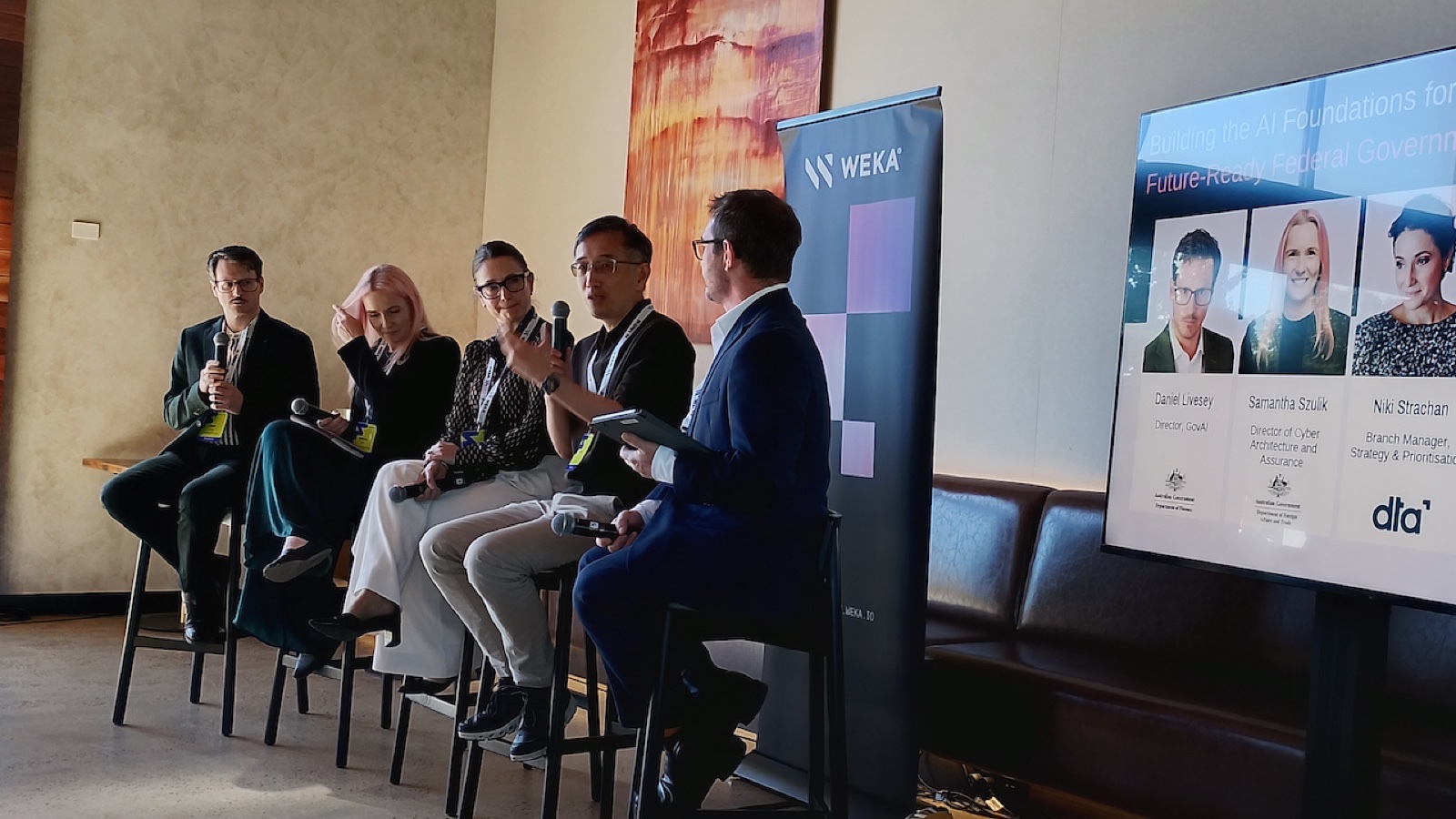
Enjoyed joining some distinguished panellists for the Sovereign by Design: Building the AI Foundations for a Future-Ready Federal Government discussion.
I shared three messages that I think deserve more attention in Australia’s sovereign AI conversation.
1. The AI stack is much richer than data centres, large language models and applications.
Between general-purpose frontier models and applications lies a substantial opportunity in industry foundation models, particularly in sectors where Australia has deep expertise and distinctive advantages: mining, energy, agriculture, environment, biosecurity and beyond.
Another often-overlooked layer is supervisory AI, which evaluates, verifies and controls the AI doing the work, improving its accuracy, performance, security and safety. Australia has considerable strengths here.
Once we understand these layers and how economic value is created and captured across them, the conversation becomes far more interesting than simply asking, "Should Australia train its own LLM?"
2. Sovereign access to frontier AI is more complicated than it sounds. And frontier capability matters even for mundane tasks.
Having access to a frontier model doesn’t necessarily mean having access to its full capabilities. Models can refuse legitimate requests, as we have seen in real-world cybersecurity defence. More subtly, access may be restricted for strategically sensitive work, such as advanced AI research that could compete with the model provider, or research that providers or their home countries consider important to their technological or economic advantage. Whether and how such restrictions are applied may not be transparent to users.
There is also a common misconception that frontier capability is mainly about solving advanced mathematics or scientific problems. Who needs a model capable of solving a Millennium Prize Problem just to summarise emails?
But the real world is messy. Consider a fairly mundane task that takes you ten hours. A highly capable AI might eventually complete that entire task autonomously, while a less capable model may manage only ten minutes before making mistakes or requiring intervention.
The difference is not necessarily the difficulty of each step, but how long the AI can reliably operate without human assistance. That has profound implications for productivity, adoption and the value of frontier capability.
3. Reusable assurance could accelerate confident AI adoption.
Our recent work at CSIRO on understanding-first AI emphasises understanding both the system we deploy and its behaviour in individual tasks. A key opportunity is to reuse and share assurance evidence across models, platforms, components and agencies, rather than starting from scratch for every use case. This could significantly reduce duplication, speed up adoption and strengthen confidence, while preserving accountability for use-specific risks.
Leave a Reply