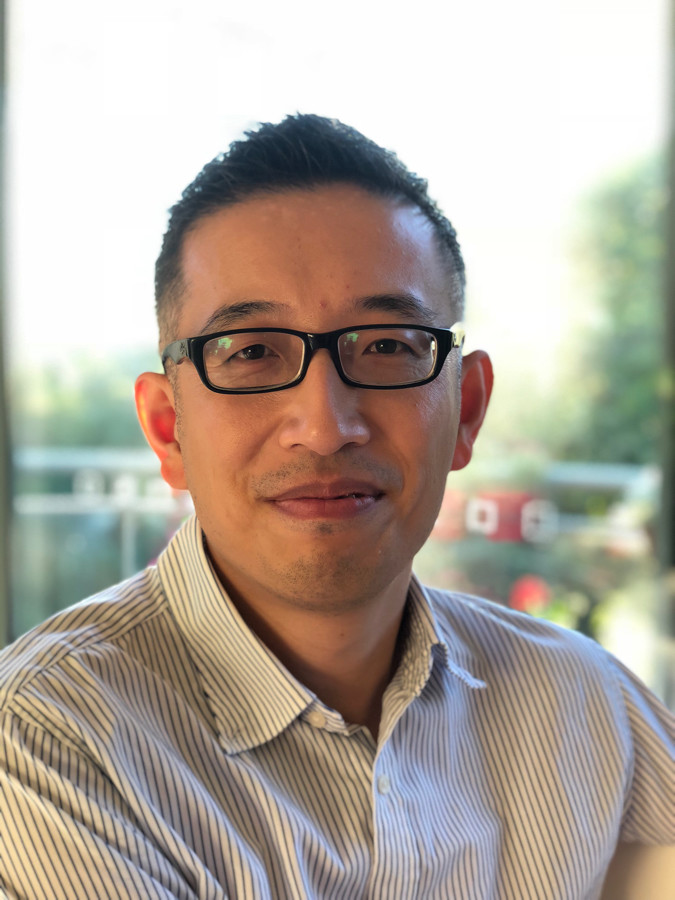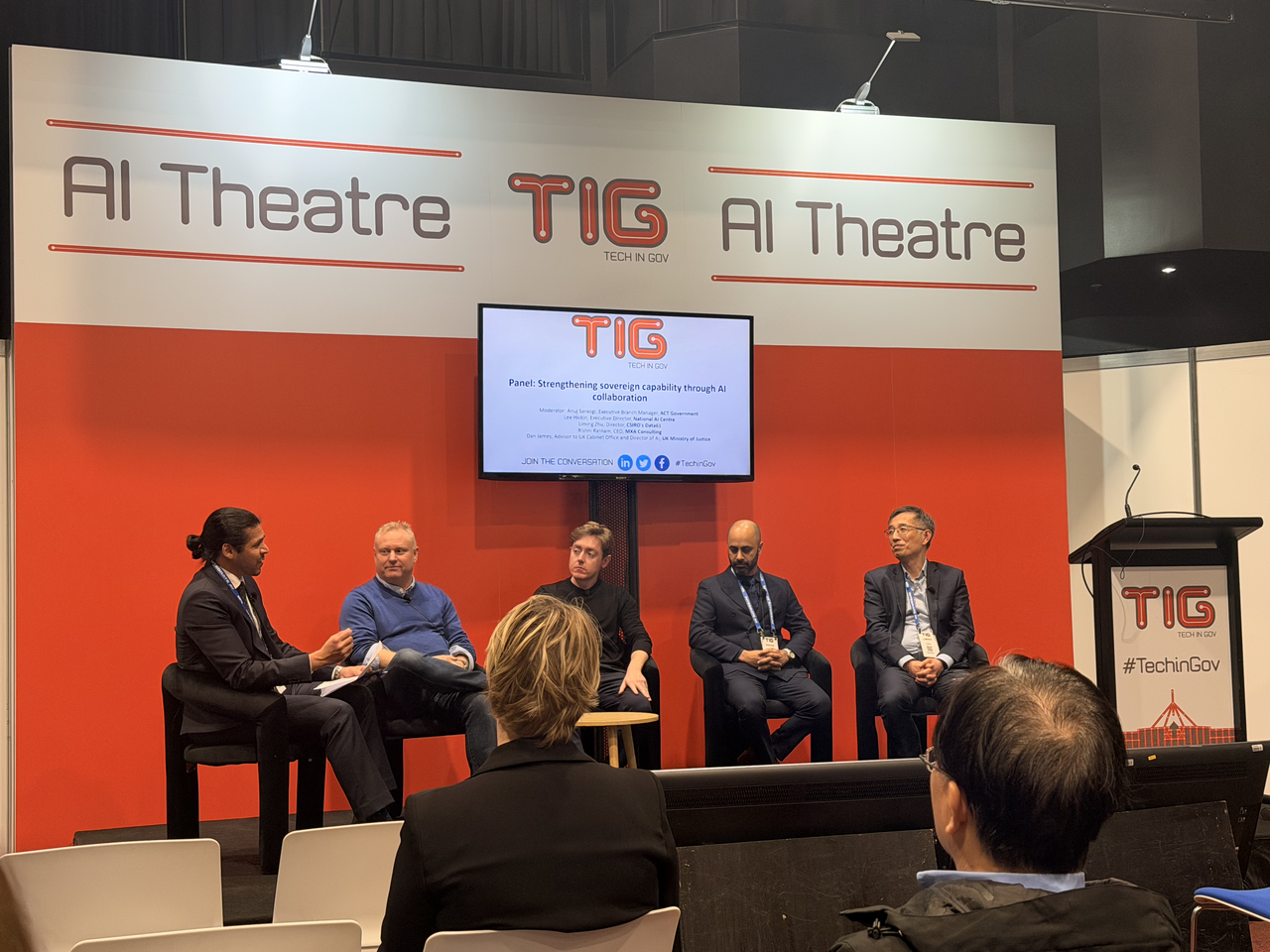
I contributed to two sessions at the Tech in Gov Conference yesterday: a panel on strengthening sovereign capability through AI collaboration, and a talk on designing human oversight in the age of AI agents.
My central point on sovereign AI was that sovereignty has three dimensions from an R&D and R&D collaboration point of view.
First, sovereign capability means assured access when it matters, particularly during a crisis. The OpenAI-Hugging Face cyber incident illustrated an important problem: even where a frontier model is technically available, it may refuse to help because it cannot reliably distinguish legitimate defensive activity from malicious intent. Safety therefore requires R&D on context-specific, system-level controls and sovereign decision-making, rather than relying entirely on safeguards embedded in the models or fully controlled by the providers.
Second, sovereignty means having the capability to extract real value from frontier AI. Much of today’s innovation is in harness engineering: the tools, workflows, memory, verifiers, orchestration, and supervisory AI that turn latent model capability into reliable system performance. This helps explain why some organisations obtain substantial value from AI while others conclude that it still does not work for them. The answer cannot be to rely on every individual becoming an expert prompt engineer, or to treat AI adoption as a traditional IT integration project. We need better systems-level innovation, which is often another form of AI.
Third, Australian R&D needs to lead in areas where it can contribute distinctive capability. World-leading sovereign capability should allow us to collaborate confidently with international partners by combining what we know with what they know. If all our AI capability comes from buying existing AI products, integrating them and applying prompt engineering, we have little technological leverage and few meaningful bargaining chips.
In my second session, I argued that human oversight must also evolve for the age of AI agents. Keeping a human inside every action loop can make the human a bottleneck, or worse, a convenient scapegoat for system failure.
A stronger model is supervisory oversight. Agents operate within a well-designed inner loop, guided by strong harnesses, constraints, and verifiers. Humans design the loop, set objectives and boundaries, monitor outcomes and consequences, investigate issues, and improve the system over time.
The future of human oversight is not continuous human intervention. It is the disciplined engineering and governance of systems that can act autonomously while remaining observable, verifiable, and controllable.
These are areas of active research focus for CSIRO.