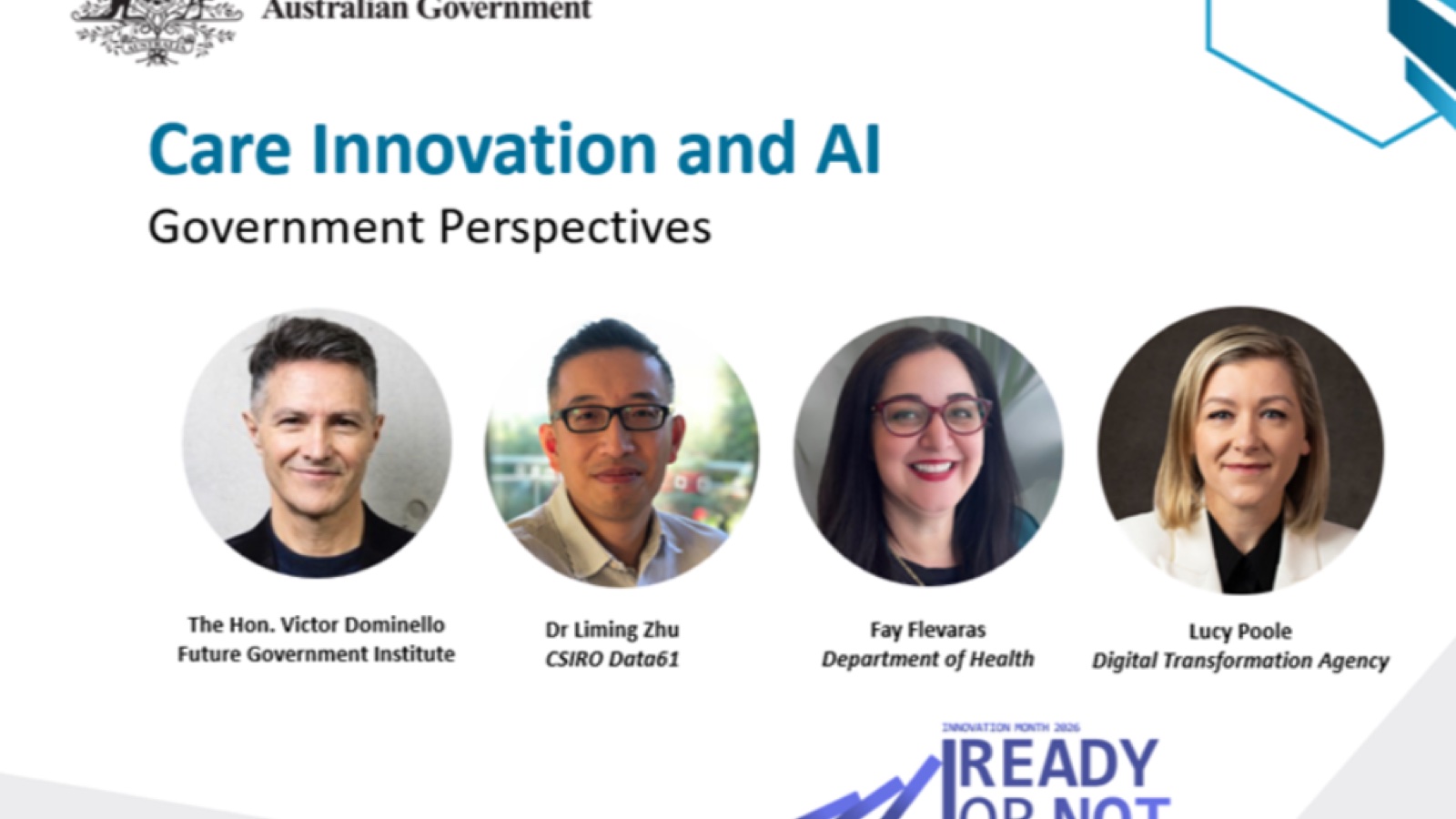
It was a pleasure to join a panel on AI in Government during Innovation Month, hosted by the Department of Health, Disability and Ageing.
Many thanks to our moderator, Victor Dominello, for leading a thoughtful discussion, and to my fellow panellists Fay Flevaras and Lucy Poole, whose perspectives on government delivery and policy complemented my own research perspective.
Across the discussion, a number of common themes emerged from the questions we were asked, particularly around how government should think about adopting and governing AI in practice.
One key theme is that AI is not just another incremental digital tool. It changes the relationship between capability and deployment. In many cases, useful capability is now available immediately through natural language interaction, without the traditional software engineering process that would normally structure risk assessment and control. This shifts the governance challenge from “how do we build and deploy a system safely?” to “how do we govern capability that is already accessible in flexible and sometimes informal ways?”
A second theme is that performance is highly context-dependent. AI systems can appear very strong in aggregate, but behave inconsistently across different tasks, populations, and settings. This makes it difficult to rely on headline performance measures alone. It also means that understanding real-world impact requires more granular evaluation—looking at where systems work well, where they fail, and what the consequences of those failures might be in specific government use cases.
A third theme is the importance of moving beyond descriptive assurance. Simply documenting intended use or relying on high-level assurances is not sufficient to understand risk. What matters is evidence: how the system performs under realistic conditions, what safeguards are in place, and how it behaves once deployed. This is why both pre-deployment evaluation and post-deployment monitoring are essential parts of any credible assurance approach.
Finally, there was a strong thread throughout the discussion about the need for ongoing governance rather than one-off approval. As systems become more dynamic and agentic, their behaviour can change over time and across contexts. This makes continuous monitoring, human oversight, and iterative evaluation central to maintaining trust and safety in operational settings.
Taken together, these themes point to a broader shift: from static governance models designed for traditional IT systems, towards evidence-based, continuously updated approaches that reflect the unique characteristics of modern AI.
Thank you to everyone who attended and contributed to an engaging discussion.