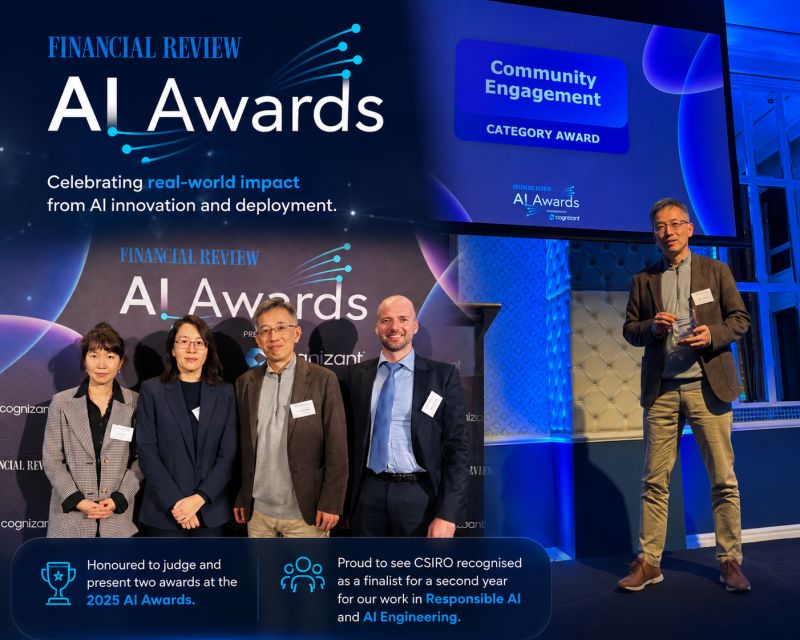
As a judge for the The Australian Financial Review(AFR) AI Awards this year, I greatly appreciated the opportunity to review such a strong field of entries. The submissions highlighted not only the breadth of AI innovation across Australia, but also the significant impact organisations are already achieving at scale.
It was a privilege to present awards to two category winners on the night and to meet and speak with many of Australia’s leading AI practitioners.
I was also delighted to see CSIRO recognised as a finalist for a second consecutive year for our work in Responsible AI and AI Engineering, helping organisations build and deploy safe, responsible AI systems, both directly and through the dissemination of industry-wide best practices.
Through conversations at the awards event, and more broadly over recent months, I came away with several observations about where organisations are creating the most value with AI.
One observation stood out.
The organisations generating the greatest value were not necessarily those using the most capable models. They were the ones that had built the fastest and most reliable domain-specific feedback loops.
Their competitive advantage came from proprietary evaluation datasets, robust evaluation suites, rapid learning cycles, and runtime controls that continuously improved system performance after deployment. In many cases, these evaluation assets and feedback mechanisms appeared to be at least as important as the underlying models themselves.
This mirrors much of the work we are pursuing at CSIRO. Increasingly, we help organisations build capabilities to refine these loops: verification-first AI engineering, reusable evaluation infrastructure and datasets across design and runtime, harness design, runtime observability and control, resumability mechanisms, cost-aware orchestration, and human-AI co-design of operating environments.
The key question is no longer only, “Which model are you using?” or “What’s your use case?”
Instead, it is:
“How quickly can your organisation learn from private evaluations and operational experience?”
“How reliably can you control your AI/Agents at runtime?”
“And do you have the infrastructure to support that?”
I’m curious: does your organisation view its evaluation suite, feedback loops, and operational learning infrastructure as strategic intellectual property? Or are they still treated as supporting assets around the model itself?