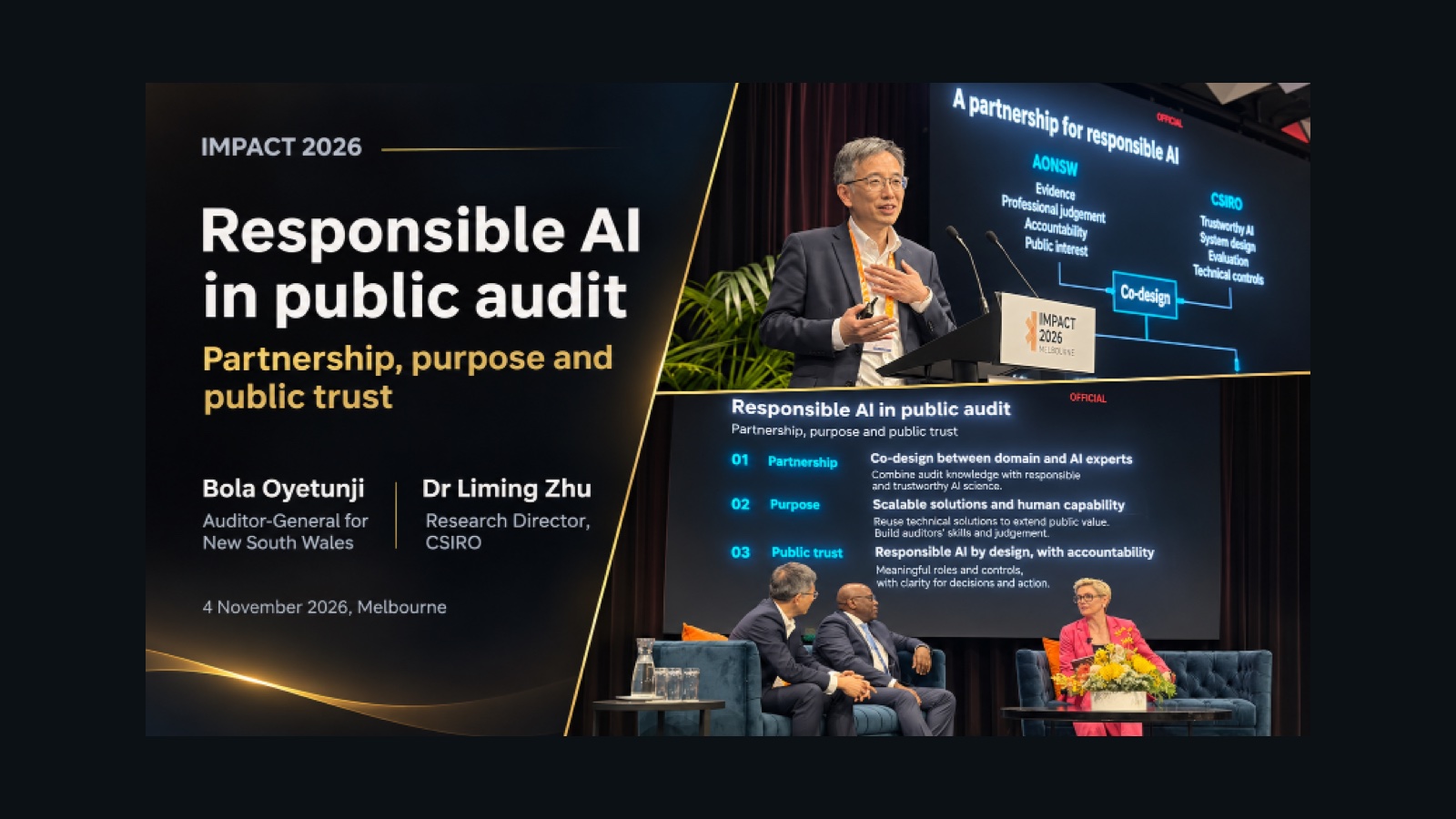
Quite honoured to co-present with the Auditor-General of New South Wales, Bola Oyetunji GAICD at IMPACT 2026 on the partnership between the Audit Office of NSW and CSIRO.
It has been a journey of learning. I’m very glad that the initial two systems we developed, Local Government Risk IQ and Budget Paper Analysis, are now deployed and producing valuable, sometimes surprising insights for auditors, impacting public auditing in NSW at scale. Beyond the substantial technical work on responsible AI and accuracy, I want to note three key things:
1. Build for clusters of use cases.
Different use cases share challenges in evidence, context, uncertainty and oversight. Reusable foundations make each additional use case potentially easier to build, with more consistent safeguards and assurance. Each context still needs evaluation, but we should not keep rebuilding the foundations.
2. Design for how expertise develops when AI does more of the work.
Understanding has always been part of our job. Historically, we have gained much of it by doing the work ourselves. As AI takes on more tasks, how do we sustain that learning, for experienced professionals and new colleagues alike?
A manager already faces a similar challenge. They don’t repeat everything their team does. They ask questions, probe assumptions, spot-check and sometimes do part of the work themselves to get a feel for it. Often the team has done a good job. The inquiry still matters: the manager needs sufficient understanding to make decisions and be accountable.
We designed our systems to support this mix of inquiry and hands-on work. Auditors can question AI’s analysis, examine and re-rank evidence, and work through parts themselves. A conversation can deepen understanding; sometimes doing remains indispensable.
The deeper challenge is to delegate execution while continuing to develop the expertise needed to ask good questions, set direction and recognise when closer scrutiny is necessary. Those capabilities need practice too.
3. Learn from the people whose work we are helping transform.
Auditors examine another party’s work, ask “Where is the evidence?”, investigate anomalies and challenge plausible explanations. That discipline has much to offer AI evaluation, safety and assurance.
When AI researchers discover that AI can sound remarkably confident and still be completely wrong, I imagine auditors thinking: "Welcome to the profession."
The technical challenges are different, but there is a wealth of professional judgement to learn from. Understanding how auditors think helps us evaluate and audit AI systems better.
That reciprocal learning makes this partnership particularly valuable. I’m grateful to our Audit Office and CSIRO colleagues for what they have taught us, and look forward to continuing the work together.
Leave a Reply