A comforting line in the AI debate is: “AI may generate, but humans will always have better judgement and taste.”
Humans probably are better today in many domains. But I would be cautious about building our future around a capability boundary that keeps moving.
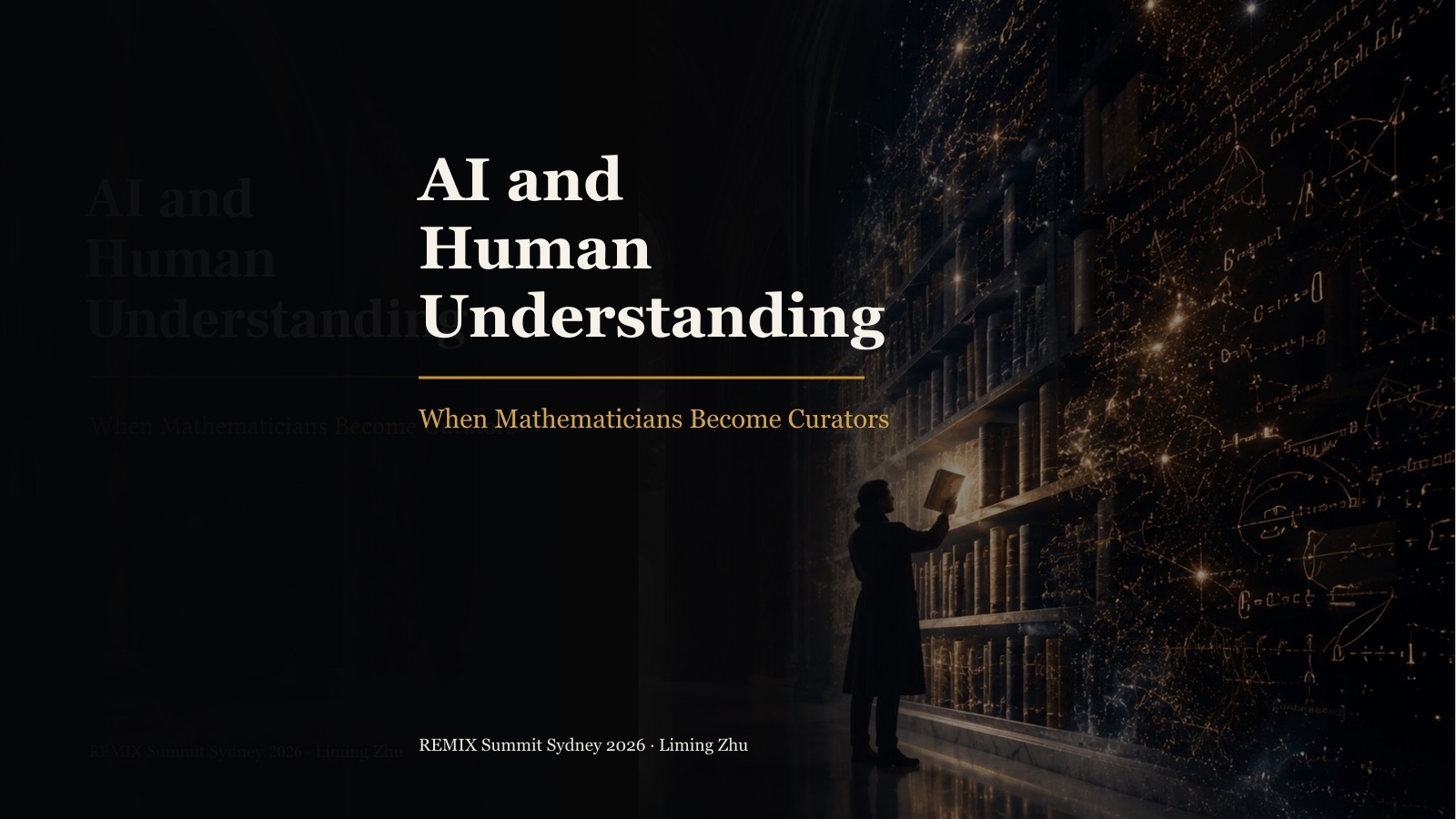
I explored this in a talk I gave last week at REMIX Summit Sydney, titled AI and Human Understanding: When Mathematicians Become Curators.
It was a slightly nerve-racking place to make the argument. Generative AI has already annoyed enough people in the creative industries, and then a computer scientist turns up and starts appropriating the word “curator”.
But the question behind the talk was serious. Instead of asking what humans will always do better than AI, what will always remain ours, regardless of how capable AI becomes?
My answer is understanding.
Not because AI cannot judge, create or perhaps even “understand” in some sense. Rather, my understanding is a state of my mind. A scientific field’s understanding is something that community has collectively developed. Humanity’s understanding is the frontier our collective mental models have reached.
That cannot be outsourced by definition.
Chess is a useful analogy. No human can beat the best chess engines. Yet human chess has not become meaningless. Players continue to deepen their understanding of positions, strategies and styles, often with the help of engines. The machine can know the better move. The human still has a frontier of understanding to push.
And understanding has an inconvenient property: it is often built through doing.
Working through the proof. Debugging the code. Making the wrong hypothesis. Trying to create something and discovering that it does not express what you meant. Comparing alternatives. Being confused. Revising your mental model.
Sometimes the friction is the learning.
There is also an implication for another popular human “last line of defence” – accountability.
Putting a human in the loop does not create meaningful accountability if that person or organisation lacks sufficient understanding to make an informed judgement. That is closer to a liability sponge, or a convenient scapegoat, than genuine accountability.
We do not need to understand every internal detail of a complex system. But accountability requires enough understanding of its behaviour, limits, evidence and consequences to make a defensible decision.
And perhaps this is where STEM has something to learn from the creative industries.
Creative work has never been only about producing another artefact. It is also about developing and expressing understanding, interpretation, context, identity and shared meaning. Making and curating are themselves part of the journey through which individuals and communities learn what they value and what they want to say.
AI may keep pushing the frontier of capability and discovery. Our enduring task is to keep pushing the frontier of our own understanding.