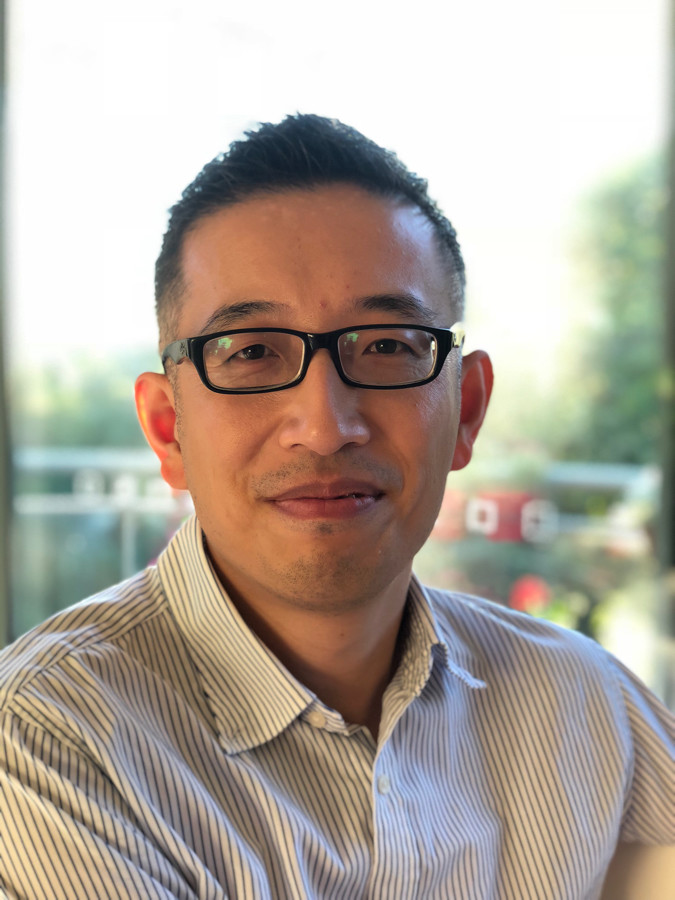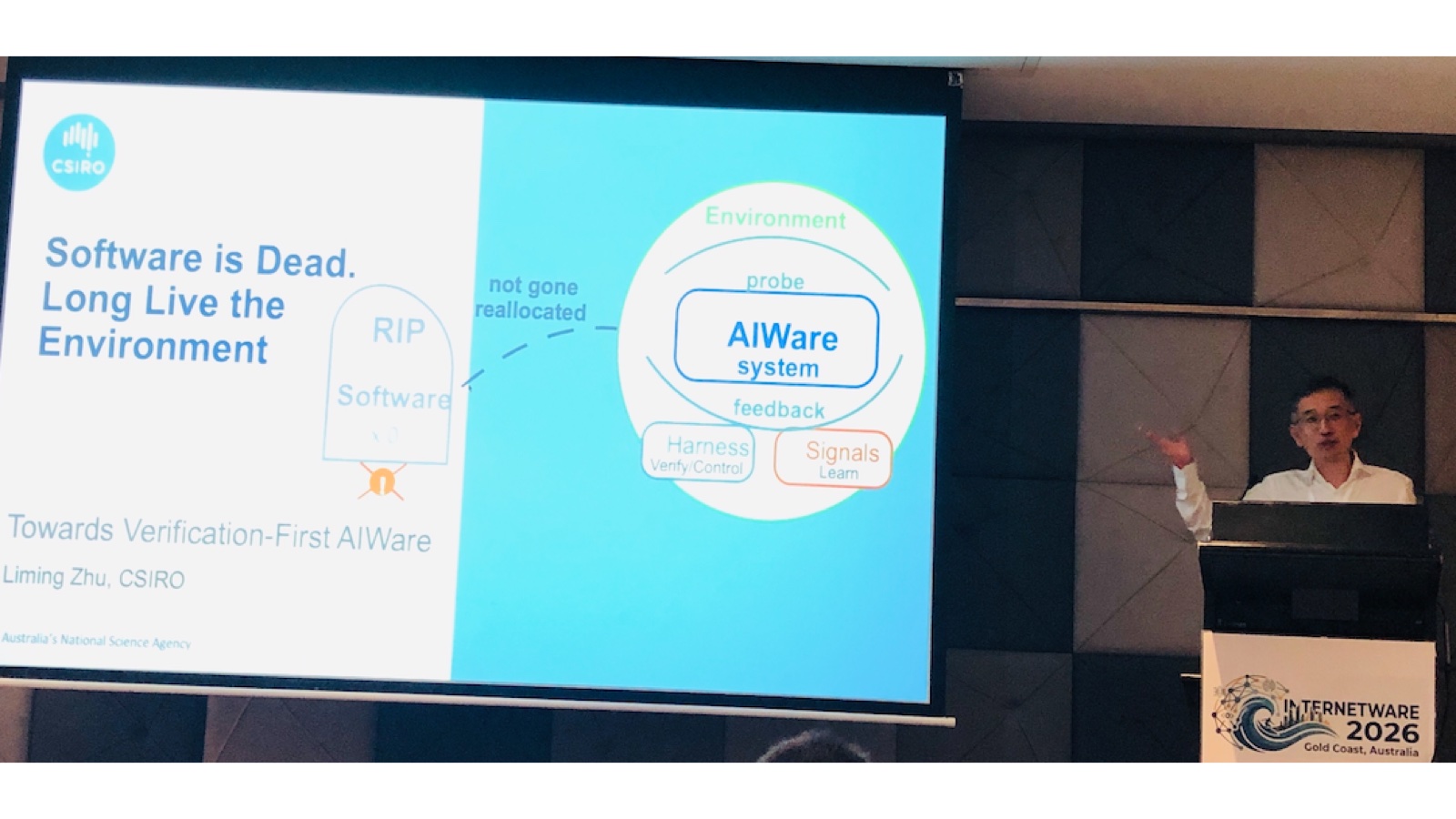
It was a pleasure to deliver a keynote at Internetware 2026 on a deliberately provocative topic: Software is Dead. Long Live the Environment: Towards Verification-First AIWare.
The core message was simple, but unsettling: software is no longer just something we “build”. Increasingly, intelligent systems—AIWare—are “grown” and improved through interaction with their harnesses and environments.
In this sense, AIWare goes beyond software written by AI or software with AI added to it. Intelligence is distributed across the system. Some resides in the model. Some comes from tools, memory, skills, code, and context. Some can only be elicited by a smart harness. Some is shaped by the environment. Only part of it is explicitly verified.
This shift changes what engineering means.
The key question moves from “How do we build the AI-enabled software?” to “Where should the intelligence live and grow?” In the model? In generated code? In memory and skills? In the harness? In the verifier? In the environment? The answer depends on reliability, speed, cost, safety, auditability, adaptability, and the kinds of evidence the system can learn from. Increasingly, systems explore these trade-offs themselves as they “self-improve” over time. The challenge is guiding this process and building trust in it.
That is why I also argued for verification-first AIWare. Verification also goes beyond checking correctness. In AIWare, it provides the signals that guide the system at both runtime and design time: what to do next, when to stop unsafe actions, when to escalate, what to improve, and where intelligence should move in the next version.
A good harness does more than test a system. It elicits capability, constrains behaviour, generates feedback, captures evidence, and supports improvement. A good environment does more than host the system. It can be probed, stressed, simulated, and shaped to reveal signals that would otherwise remain hidden.
This also makes human understanding central. Humans are not only error catchers or system designers. We express intent, define what matters, judge acceptability, and shape the verification surfaces through which AI systems learn what is valuable and safe. Through this process, we also refine our own understanding of the system and our criteria.
My message to the community was that the next frontier is not only bigger models or better code generation. It is harness and verifier design, loop engineering, environment shaping, and runtime learning infrastructure.
The AI race may not be won by whoever has the most capable model. It may be won by whoever is best at building harness and environments that elicit, verify, constrain, and grow intelligence. That’s what we do at CSIRO.
Slides at https://www.linkedin.com/feed/update/urn:li:activity:7485084241890914304/