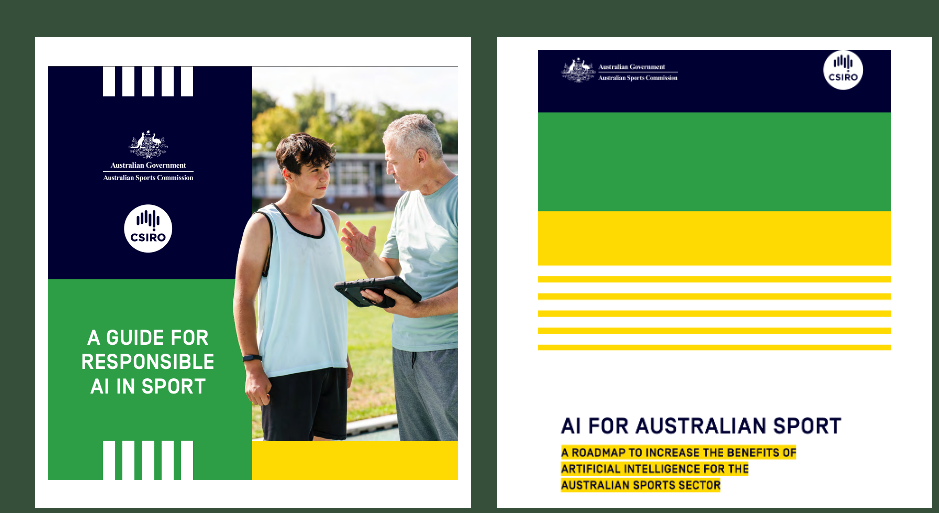
I’m very proud of two pieces of work we have released with our partner, the Australian Sports Commission: A Guide for Responsible AI in Sport and AI for Australian Sport.
Together they form one of the world’s first national playbooks for how AI should be developed and used responsibly across the sporting ecosystem. The work is particularly meaningful in Australia, one of the world’s leading sporting nations, with among the highest participation rates and Olympic medals per capita.
One thing this work reminded me of is that the most exciting scientific impact rarely comes from advancing AI in the abstract. It happens when general technologies meet the difficult, nuanced problems of a specific domain.
The work also made me reflect on a broader question I hear often: where will humans remain essential if AI becomes increasingly capable?
Sport offers a useful lens. AI can analyse performance patterns, optimise training and reveal strategies no human could easily derive. Yet the real value comes from humans learning from these systems.
Sometimes that learning pushes the boundaries of knowledge. Sometimes it simply improves personal skill. Chess is a well-known example. Superhuman engines did not end human chess. They dramatically raised the level of play, participation and inclusiveness because anyone can now train every day against a stronger teacher.
The same dynamic appears in many professions. Doctors, lawyers, engineers and coaches increasingly rely on AI systems that may outperform them in some tasks. The role of the expert is not always to catch AI mistakes. Often it is to understand what the system is doing, connect AI reasoning to human concepts and logic, learn from it, explain decisions to others, and take accountability for them.
There is also a deeper human dimension. Even when an AI system produces a superior recommendation, people still want to know that a knowledgeable professional understands the decision and stands behind it. That assurance, both intellectual and emotional, matters.
AI in sport offers a glimpse of that future: machines expanding human capability, while human learning, understanding, translation and accountability remain central.
Now I’m off to my morning tennis. I just need AI to fix my forehand so my wife doesn’t have to grudgingly sprint half the court chasing my “accidentally tricky” shots.