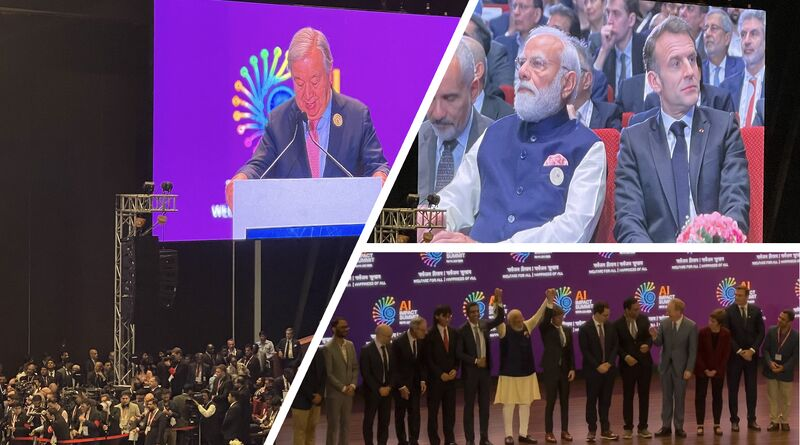
Day four was what happens when strategic autonomy meets market dominance in the same auditorium.
With tightened entrance security and roadblocks across New Delhi, I had to arrive at Bharat Mandapam almost two hours before the official start, carrying only my phone. Even my uniball pen was nearly dismantled for inspection. But it was worth it.
The compressed agenda read like a who’s who of global AI and politics, each delivering tightly timed 5-8 minute addresses: UN Secretary-General António Guterres, President Emmanuel Macron, Prime Minister Narendra Modi, alongside CEOs from Google, Anthropic, OpenAI, Microsoft, Infosys, Tata, Adobe, Accenture, Meta AI and many others.
The UN Secretary-General put it bluntly: “Because the future of AI cannot be decided by a handful of countries – or left to the whims of a few billionaires… AI must belong to everyone.”
With many of those billionaires and CEOs seated just metres away, the line landed. There was an audible chuckle in the hall. The live cameras performed their own form of evaluation, cutting to micro-expressions that suggested the point was not entirely abstract.
He went further, noting that the UN has taken a decisive step to establish an Independent International Scientific Panel on AI. And here is the part that made me quietly proud: our very own leading scientist Qinghua Lu is on that panel. In a sense, humanity is in her hands.
The “New Delhi Frontier AI Commitments” were unveiled. The two commitments resonated deeply with our work:
First, advancing real-world, post-deployment insight. Not just benchmarks and lab claims, but evidence from actual use.
Second, multilingual and contextual AI evaluation. Evaluation again. Real-world, context-specific evaluation, linked to risk control and guardrails.
It is another small step, but a step in the right direction.
In the evening, I headed to the beautiful Australian High Commission in New Delhi for a garden reception. Minister Andrew Charlton and Ambassador for Cyber Affairs and Critical Technology Jessica Hunter shared their perspectives on AI’s impact, cyber security and critical technologies. I shared my view that the intersection of AI, cyber and critical technologies is where the most interesting opportunities lie, where CSIRO’s Data61 is deliberately focusing its efforts, and perhaps exactly where Australia can position itself for a prosperous, secure and sovereign future.
Day five, the final day, I will be involved in more sessions and deeper discussions on AI safety, including Global South and regional efforts. Stay tuned for my final update.