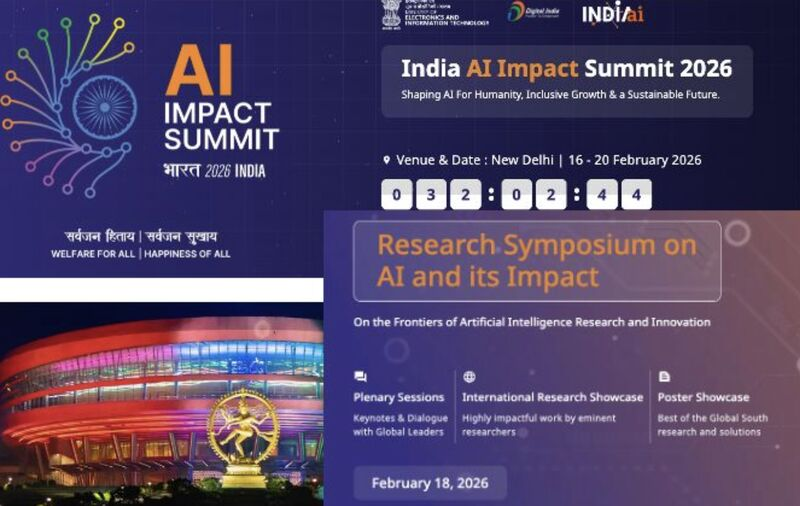
Reading “Being Indian” by Pavan K. Varma on the flight into New Delhi was an unexpectedly good prelude to the Indian AI Impact Summit. The book wrestles with identity, continuity, and contradiction in a civilisation that absorbs shocks without losing coherence. It made me reflect on how we are currently talking about AI.
I’ve just arrived for a full week of exhibitions, research sessions, and ministerial discussions. I’ll share what I learn each day. I’m also arriving with two contested questions I’m keen to test.
First: even if frontier model capability plateaued today, the real acceleration may still lie ahead. Post-training optimisation, tool integration, inference-time scaling, and system composition (compound AI), can unlock substantial new capability. But they also introduce new risk surfaces. Is AI science and governance shifting from model-level thinking to system-level thinking fast enough?
Second: much of today’s ingenuity sits in system scaffolding. Yet increasingly simple orchestration, combined with sufficient inference-time compute, can sometimes outperform carefully engineered structures. Is system-level engineering advantage, or the skills to use AI effectively, transient? Among the many aspects we focus on, which are likely to persist? Will inference-time compute and access to compute become the real differentiator, and perhaps the next digital divide?
At CSIRO’s Data61 we work across the model-system spectrum, while my personal research focus is AI system-level engineering and safety. If you’re here this week and thinking about these questions, I’d welcome the conversation.
I’ll be speaking on several panels, including the research symposium day session at 2pm. See you around.
About Me
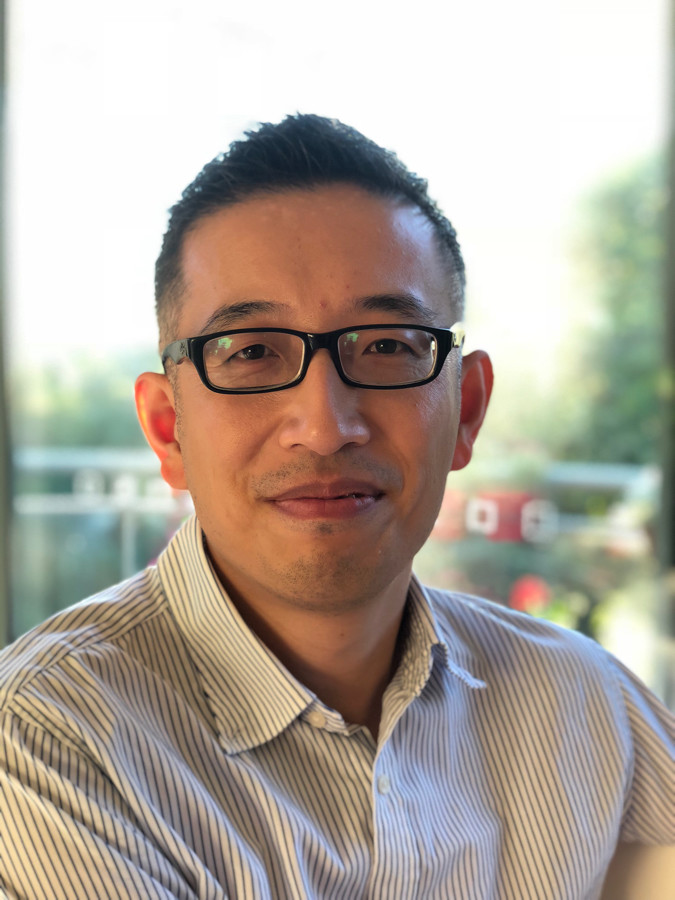
Dr Liming Zhu FTSE
Research Director, CSIRO
Conjoint Professor, CSE UNSW
For other roles, see LinkedIn & Professional activities.
If you’d like to invite me to give a talk, please see here & email liming.zhu@csiro.au